Pop Music Is Slowly Becoming Great Again
Popular Music Genres
These pages look at the vocabulary of Popular Music through its history, genres, people and songs. Each page has a Wordchecker—with instance sentences—to explain vocabulary on that page. For a full listing of vocabulary used see Vocabulary of Music.
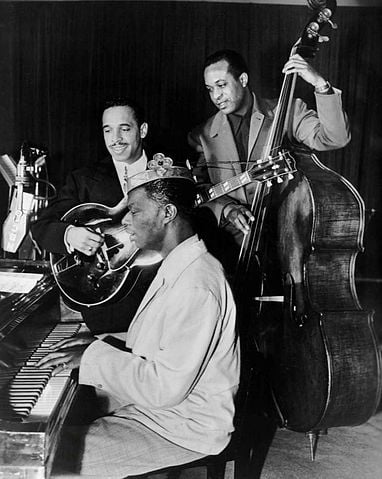 Nearly all of the nearly important genres of popular music in the final century have come up from the USA. This is where African and European musical traditions came together, and it's this mixture of traditions that gave nascency to popular music.
Photo correct: The Nat King Cole Trio, with Nat at the piano, in 1948 (NBC Radio Public Domain)
What is Pop Music?Only what is Pop Music? Is it pop or pop? This page explains all.
- Blues Music
- Jazz Music
- Rhythm and Blues Music
- Rock and Scroll Music
- Rock Music
- Land Music
- Soul Music
- Trip the light fantastic Music
- Hip Hop Music
Blues
When millions of Africans were transported to America as slaves in the 18th and 19th centuries, their melodies and rhythms went with them. They knew that singing together made working easier, and it was in these piece of work songs that African rhythms and melodies were preserved until slavery ended in 1865. Many African Americans became Christians and sang hymns in church. Others learned to play popular songs and dance tunes for coin. Simply whenever they sang and played, the African rhythms of the old work songs could be heard. And when they expressed their feelings by creating new songs, African melodies could be heard in the tunes.
It was this new combination of African and Western music that led to the genre we at present call "blues". Some blues songs told stories of heartbreak and pain, and these were often dull and sad. Just others were about being in love, or having fun, and these were up-tempo and expert to dance to. Various blues styles adult over the years, some in small towns of the American s and others in cities like Chicago and New Orleans. But wherever the music was played, listeners heard a sound that was going to influence nearly every genre of popular music to come, from jazz and soul to hip hop. If you'd similar to hear some early on dejection, try searching for the recordings of Blind Willie McTell, Bukka White and Lightnin' Hopkins. For afterward blues, attempt Billie Vacation, Muddy Waters, Howlin' Wolf and John Lee Hooker.
Jazz
Near African American musicians but played blues, but some played classical music too and learned European harmony. Some fifty-fifty mixed European harmony with the rhythms and scales of blues, and it was from this mixture that "jazz" was born. One of jazz'south greatest musicians was the trumpet player Louis Armstrong, who helped to develop many styles of jazz. He was in New Orleans, his domicile town, in the 1910s when the marching-band style of New Orleans jazz (or "dixieland") was existence built-in. In the 1920s he was in Chicago inventing new ways of improvising with Joe "King" Oliver and his ring. Then he was in New York City in the 1930s when big band jazz and swing were developing. These new styles were played past jazz orchestras with a rhythm section (drums, double bass, piano and guitar), contumely and woodwind sections, and sometimes strings and one or more singers. Swing was hugely popular in the 1940 southward, becoming the music that nearly anybody danced to. Some of the greatest jazz orchestras were those led past Knuckles Ellington, Count Basie and Fletcher Henderson, with whom Louis Armstrong played. All the most popular singers of the mean solar day, like Bing Crosby, Frank Sinatra and Nat Rex Cole, sang with jazz orchestras.
But past the 1950s many young musicians no longer wanted to play in jazz orchestras. They wanted the freedom to improvise and began experimenting in their ain bands. Earlier long they were playing exciting new styles like bebop and modal jazz. These new styles weren't equally easy to dance to equally swing, so they weren't as popular, but they found a new audience of serious listeners for whom mod jazz was art music rather than pop music. The best of these musicians included Charlie Parker, Thelonious Monk, John Coltrane, Miles Davis and Charles Mingus.
Rhythm and Blues
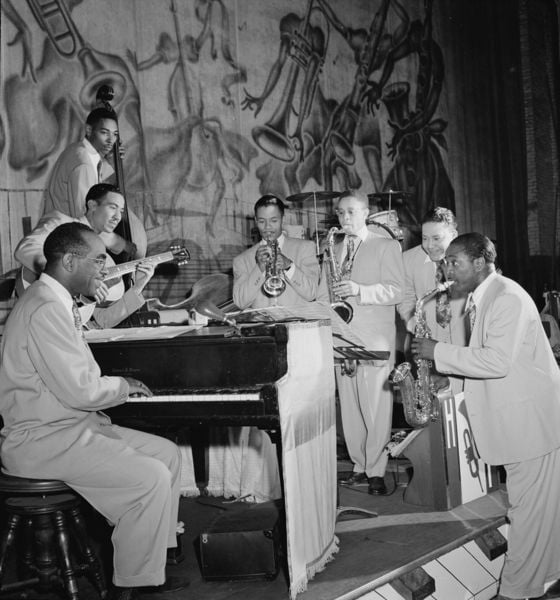 As jazz was becoming more than and more popular in the 1930s and 1940 south, another new genre was starting to develop. Many African Americans were professional blues musicians, simply making money wasn't piece of cake. They formed small bands and looked for work in inexpensive confined and clubs. Simply to get work, they had to concenter audiences. Most young people who went to these places thought blues was onetime-fashioned, so the bands had to develop a new style, and what they created was "rhythm and blues" (or R&B*).
Photo correct: Louis Hashemite kingdom of jordan'due south Tympany V in New York, mid-1940's (William P. Gottlieb Public Domain)
The early forms of R&B were loud and lively and mostly played on drums, double bass, and electric guitar. Singers were men or women with large voices, and audiences loved it. The style quickly spread throughout the state, with larger bands adding pianoforte, trumpet and saxophone. R&B was great fun and perfect for dancing, and past the mid-1940s many bands were selling records. Ii of the biggest sellers were T-Os Walker and Louis Jordan's "Tympany Five", who had a number-one hitting in 1944 with G.I. Jive. Later R&B artists include Ruth Dark-brown, Bo Diddley, Muddy Waters and Ray Charles.
*The term "R&B" is now used to draw romantic soul songs and ballads, a very different mode to the original R&B.
Stone and Roll
Past the early on 1950 s, another new genre called "stone and gyre" (or "rock'n'gyre") was beingness created by musicians who could play both R&B and Western Swing, a popular style of country dance music. This new music was played on the aforementioned ready of instruments as R&B - electric guitar, double bass and drums - with the guitarist often singing as well. Information technology had a strong blues beat and an R&B feel, but the melodies were similar those of country music. It was great to dance to, and stone and curlicue dance styles soon developed as well. The lyrics were fun to heed to, and information technology quickly became popular, especially when teenagers heard rock and roll records on the radio.
One of the showtime bands to record was "Neb Hayley and His Comets" who had a hitting single with Rock around the Clock in 1954. They were greatly influenced by R&B artists like Louis Jordan and Big Joe Turner, as were many others like Picayune Richard and Chuck Berry, whose 1956 single Curl Over Beethoven became a huge hit. Jerry Lee Lewis, who amazed audiences with his wild piano playing, also became very popular.
But rock and scroll seemed wild and dangerous to many parents, especially when they saw the sexy dancing of a handsome young singer named Elvis Presley. In that location was zero they could exercise to cease their kids from loving stone and coil and being fans of Elvis, however. He became hugely successful and made stone and roll one of the most popular styles of music not only in America, but across the world. Elvis had many hit singles, including Hound Canis familiaris, Heartbreak Hotel and Jailhouse Rock, and he soon became known as "the king of rock and coil" or just "the king".
Video: Big Joe Turner performing his 1954 song Milk shake, Rattle and Roll
The 1960s
In the early 60s a new genre chosen Rock Music began to develop when young musicians combined the stone and roll of artists like Elvis with elements of R&B. New styles of Land Music also became pop in the 60s, as did a new mode of melodic R&B chosen Soul Music. Later in the 60s soul artists like James Brownish developed a more rhythmic way called funk, and funk led to many new styles of Trip the light fantastic toe Music in the 70s, the 80s and beyond. In the late 70s a new genre called Hip Hop also developed. Hip hop is at present i of the most popular styles of music in the globe, and like all major genres of popular music it'southward produced many hit singles on the Popular Music charts.
Best-selling Popular Music Artists of All Time
The popularity of artists is usually measured by the number of singles and albums they sell, and sales are listed in the music charts. The ten almost successful artists of all time are listed below. Read the listing and run into how many different genres of pop music you can observe.- The Beatles - British pop and stone band
- Elvis Presley - American rock and roll, pop and gospel artist
- Michael Jackson - American soul, pop and dance-pop creative person
- Madonna - American popular and dance-pop artist
- Elton John - British rock and pop vocalizer-songwriter
- Led Zeppelin - British blues, R&B and rock band
- Pink Floyd - British stone band
- Mariah Carey - American pop and soul artist
- Celine Dion - Canadian pop, soul and jazz creative person
- Whitney Houston - American pop and soul artist
Did you detect that the list doesn't include any young artists? This is because they haven't had fourth dimension to sell as many recordings as the artists listed. But if yous await at a similar list in a few years, you might notice some of today'southward popular artists included too.
anthology (substantive): a tape or audio file with an ordered drove of songs - Michael Jackson'south album Thriller has sold more than copies than any other album.
ballad (noun): a boring vocal usually well-nigh love - Janis sings upwards-tempo rock songs likewise every bit slow ballads.
bebop (noun): a complex mode of up-tempo jazz from the 1950s - The best bepop player I ever heard was Charlie Parker.
large band (substantive): a big jazz band, esp. ane that plays big band jazz - Most popular singers of the 30s and 40s had their own big bands.
brass (substantive): instruments made of brass, incl. trumpet, trombone and tuba - Australian rock band "The Saints" used a brass section on their second album.
(the) charts (noun): a list of the best-selling singles or albums of the previous calendar week - That vocal Happy by Pharrell Williams was at the summit of the charts for weeks.
dance-popular (noun): up-tempo pop music with a dance rhythm - Lady Gaga has produced some not bad trip the light fantastic toe-popular singles.
double bass (noun): a large stringed instrument for playing depression notes - In jazz, double bass strings are plucked instead of bowed.
fan (substantive): someone who likes a particular creative person or band very much - Barry'southward a really big fan of Bob Dylan.
gospel music (noun): rhythmic church music of African American Christians - We heard some great gospel music in those former churches.
hit (noun): a best-selling vocal near the top of the music charts - One of the biggest hits e'er was Bohemian Rhapsody past Queen.
hymn (noun): a religious vocal that's sung in church - My grandma loves singing those quondam hymns.
improvise (verb): to invent music spontaneously while playing - If you want to be a jazz musician, you have to acquire how to improvise.
modal jazz (noun): jazz that uses Arabic or Indian modes instead of European scales - John Coltrane played some bully modal jazz.
record (noun): a thin disc of blackness plastic on which recorded music is imprinted and sold - I bought lots of punk rock records in the 1970 south.
scale (noun): a series of notes in a fixed order from lowest to highest - The major and minor scales each accept 7 notes.
singer-songwriter (noun): a musician who writes and performs his or her own songs - Most vocalist-songwriters play guitar or pianoforte while singing.
single (noun): a small tape with a song on each side, or a audio file with one song - The Beatles had more hitting singles than any other band.
soul (noun): a style of music that combines R&B and gospel music - Ii of my favourite soul singers are Al Green and Marvin Gaye.
strings (substantive): an orchestral cord department with violins, violas, cellos and double bass - But the biggest jazz orchestras had strings.
swing (substantive): up-tempo jazz for dancing played by big bands or jazz orchestras - Benny Goodman wrote lots of swing tunes.
melody (noun): a vocal or melody - I know the tune, just I can't call back what information technology'due south called.
upwards-tempo (or "uptempo") (describing word): having a fast shell - If you want to write a happy vocal, it should be up-tempo.
woodwind (northward): instruments played by bravado across a hole (due east.1000. flute) or through a reed (eastward.m. saxophone) - Are y'all certain the saxophone is a woodwind musical instrument?
beltonyoureand1971.blogspot.com
Source: https://www.englishclub.com/vocabulary/music-popular.htm
0 Response to "Pop Music Is Slowly Becoming Great Again"
Post a Comment